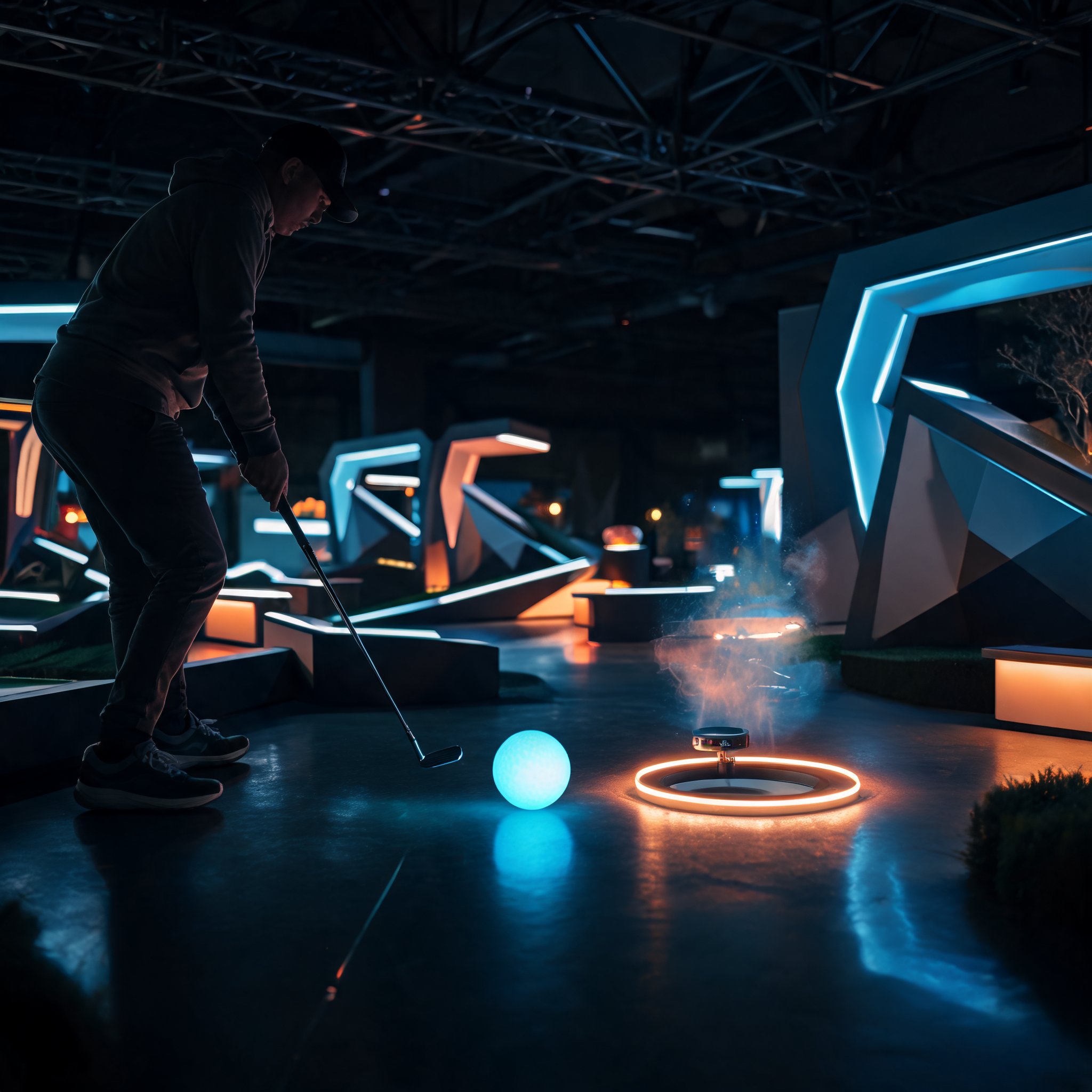
360Golf, Holovis' miniature golf brand, is repositioning the familiar putting format as a technology platform aimed at the competitive socialising market. Rather than replace the game, the system adds automated scoring, gamified challenges and venue analytics on top of it, and is being installed in settings that range from retrofitted mini golf courses to the decks of cruise ships.
The company argues that the format's advantage is that it needs almost no explanation. Stuart Edgington, global director of business development, describes mini golf as one of the world's most accessible leisure activities and says the technology is built on that existing understanding rather than replacing it. Visitors register, collect an assigned smart ball and start playing, which keeps staffing demands at the entrance low and lets the format serve families, competitive young adult groups and corporate bookings alike.
Scoring first, then gamification
The base layer is automated scoring. Smart balls, tees and cups work with the HoloTrac scoring system, removing paper scorecards and acting as a referee when contests are close. On top of that sits a set of gamified features: SuperShots that offer alternative ways to score, Triumphs that present awards and unlock new challenges, plus bonuses, on-course games, player accounts, achievements, leaderboards and video celebrations. Matt Dobbs, business development director, says the aim is to give players more reason to compete, celebrate and compare results, and therefore more reason to come back.
Data as an operating tool
Behind the game layer is DeepSmarts, an AI analytics engine that shows operators and Holovis how players move through a course, along with seasonality and uptime. Edgington frames it as an additional service: insight that helps venues adjust operations, and in some cases remote diagnosis when equipment misbehaves. Project manager Maaz Ussen says engineers can review what happened on a course remotely when a venue reports an anomaly.
That data underpins a design intended to raise dwell time and secondary spend. 360Golf cites capacity of up to 80 players per hour per course. Dobbs argues the self-service kiosk flow, in which guests learn the game, collect a ball and play, frees operational staff to look after guests and food and beverage, which he links directly to revenue. Operators can also use the analytics to target quieter periods or under-served groups with promotions.
From retrofit to custom build
Deployment options are deliberately broad. Tech-only packages can be retrofitted into existing mini golf attractions in roughly six to eight weeks. Catalogue holes from a tested library can be installed and ready to play in eight to 12 weeks. Fully custom courses take six months or more; the Top 9 course at Netflix House is cited as a bespoke, IP-led installation with unique hole designs and multiple custom interactive elements.
Some sites demand engineering rather than theming. Tee Time, the brand used for Norwegian Cruise Line, has four installations and uses marine-grade, IP-rated hardware including rugged cups and tees and specialist screens to deliver the same experience at sea. At Lucky Duck in Norway, a custom course offers two routes for each hole, adding choice while making use of the available space. Ussen says physical design and technology are developed together, drawing on the team's accumulated knowledge of which hole designs work and where adjustments are needed.
Operating evidence at Butlin's
At Butlin's Bognor Regis resort, the PLAYXPERIENCE indoor activity centre includes three nine-hole 360Golf courses: one with neon glow effects, a Las Vegas-themed layout and a wheelchair-accessible music-themed course. The £15m project opened in 2024, and Dobbs says the tech-putt attraction has reached around 5,000 players and roughly £40,000 in revenue in a busy week, exceeding the client's expectations.
The project also pushed the team further into inclusive design. Examples include making holes playable right- and left-handed, sizing putters for taller guests, allowing wheelchairs close to or onto the course, and leaving enough space between holes to reduce crowding and safety hazards.
Multi-site consistency and the limits of the model
For operators running several venues, the shared technology provides a baseline. Edgington points to Saudi Entertainment Ventures (SEVEN) and Ireland's Super Social, which uses 12 holes from the sports-themed package, as clients seeking repeat visitation; theming, layout and branding can then vary around that consistent core. Smaller venues can take a cheaper, simpler course while keeping the same scoring and replayability, which the company sees as a starting point for operators building toward a chain.
The company is also candid about the market. Edgington expects competitive socialising to reach saturation eventually and says Holovis is investigating adjacent markets. It is working with Roxy Leisure to add stroke-counting technology to crazy pool tables, and Ussen says the ambition is to apply the technology to other sports. How far that travels will depend on finding clients whose venues suit the format, the same condition Dobbs sets for new golf projects, where discussions begin with venue constraints, target audience and commercial model rather than the course alone.
Where to see it
360Golf is exhibiting at the Land Leisure & Tourism Show at NEC Birmingham on 4–5 November, at booth LLT360 in the Holiday Village, and at IAAPA Expo in Orlando from 16–20 November at the Holovis booth, #S448. Playable demonstrations can be booked at the 360Golf Orlando office, a short distance from the convention centre.