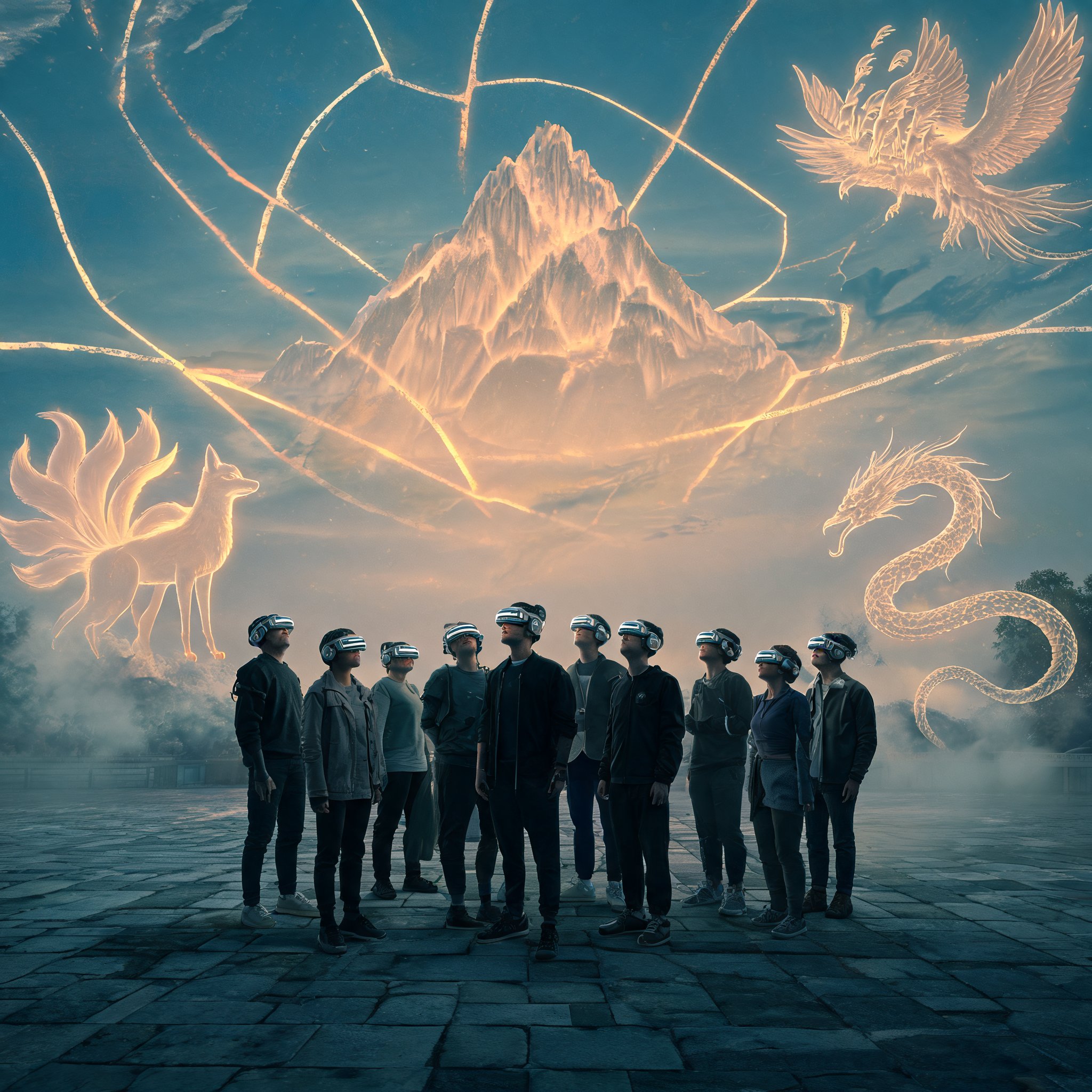
AStation has adapted the Shan Hai Jing — the ancient Chinese collection of myths known as The Classic of Mountains and Seas — into a location-based mixed reality attraction that visitors explore on foot outdoors while wearing Apple Vision Pro headsets. The company describes the piece, titled Shan Hai Jing™: Time-Travel Into China's Oldest Legend, as an attempt to turn a written tradition into something guests can physically enter and interact with.
The source material dates back more than two thousand years, when Chinese storytellers began recording tales of strange lands, strange animals and gods. Among them is the legend of Nuwa, a goddess who mends a broken sky. AStation positions these stories as foundational to Chinese culture in the way Greek myths underpin Western culture, while noting that they remain little known outside China.
An outdoor stage with a mixed reality overlay
Guests move through an outdoor area of up to 2,000 square metres. They continue to see their companions and their actual surroundings, with a mixed reality mountain layered into the scene. The experience begins when a god, enraged by the loss of a great battle, strikes the mountain with his head and shatters it. Because the mountain supports the sky, the sky tilts and the ground falls away on one side.
According to AStation, ancient storytellers used this episode to account for natural phenomena — why China's rivers run toward the sea, and why the stars appear to wheel overhead. In the attraction, guests observe the same events, including the sensation of the ground tilting beneath their feet.
Creatures from the old stories
From there, visitors enter what AStation calls the "Realm of the Crumbling Sky." More than a dozen scenes unfold, and hundreds of creatures drawn from the myths approach the group — nine-tailed foxes, nine-headed birds, dragons and part-human, part-animal beings. As guests move deeper into the space, these figures reveal further parts of the legend, with the company aiming to give visitors the sense of walking inside a story older than the Great Wall.
The effect relies on AStation's Enterverse™ technology, which maps the myths directly onto real outdoor ground. The company says the approach requires no cables, no handheld controllers and no indoor stage, and that the narrative is embedded in the terrain rather than displayed on a screen. Up to 120 guests can occupy the shared space at the same time, so the sky breaks for the whole group rather than for one visitor alone.
Harmony as the underlying theme
AStation frames the work as more than spectacle. In the myth, anger damages the world, and Nuwa melts coloured stones to patch the sky and restore balance. The company links this to héxié (和谐), or harmony, an idea it says Chinese culture has returned to for thousands of years: when something breaks, someone must take on the patient work of repair. The attraction is designed to let guests stand at the moment of fracture and consider why that duty became an enduring value.
AStation also points to a broader cultural revival in China, in which society is re-engaging with its ancient heritage, as a factor behind its rapid domestic growth. It notes that culture and technology are both core pillars of the country's current Five-Year Plan. The company states that Shan Hai Jing was produced entirely in-house with no external partners, and clarifies that a supporting video references a different title, Cosmos, only to illustrate how a story can be staged on the Enterverse platform generally.