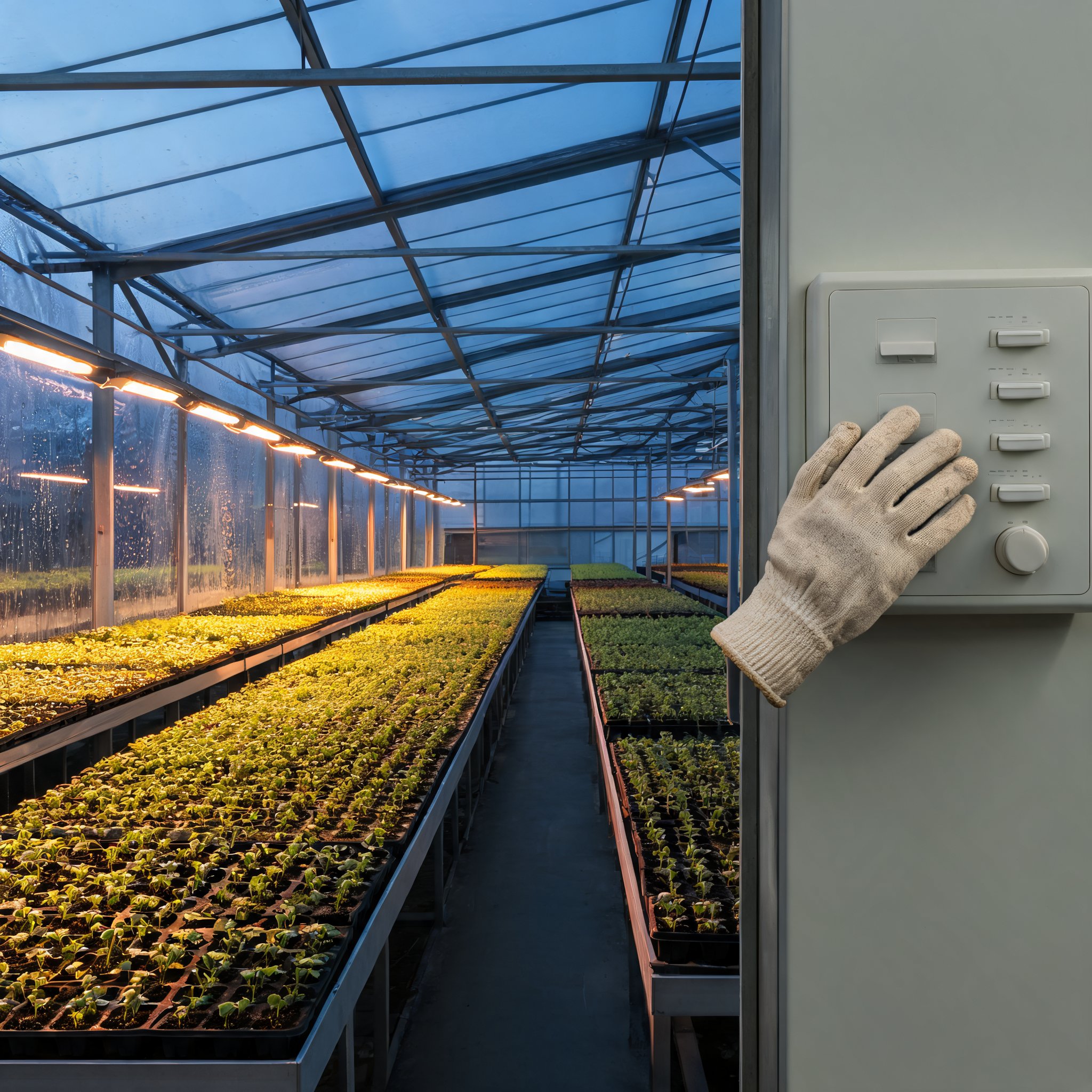
Greenhouse growers who scan their electricity bills for cost trends may be overlooking a number that matters more during a grid emergency: the rotating outage group or block printed on many California utility bills, which shows where a site stands in line when power supplies run short.
Every grower holds a place in that sequence whether or not it appears on a bill. Federal reliability standards — NERC's EOP-011 — require grid operators nationwide to maintain emergency plans for cutting load, according to Ian Knisely, an energy analyst at Energy Bridge Advisors. California is unusual in printing the information directly on the utility bill.
Why greenhouses are exposed
When those emergency plans are triggered, power is shut off systematically, often with only minutes of warning. Hospitals and similar critical facilities are protected where possible, but nearly everyone else — greenhouses included — is at risk. Rolling outages have struck several regions in recent years during both heat waves and winter storms, and for a greenhouse that means fans, pumps, irrigation, heating and controls can go dark at the worst possible moment.
Knisely draws a distinction between an outage and a curtailment: control. In an outage everything stops at once. In a planned curtailment, the grower decides ahead of time which loads drop, by how much, and which stay on to protect the crop.
Four steps to a curtailment plan
A curtailment plan is a written playbook for the hours when the grid is stressed. Knisely outlines four steps.
- Inventory the loads. List major equipment and roughly how much power each piece draws — supplemental lighting, fans, evaporative cooling, heating, pumps, dehumidification, controls and any cold storage.
- Sort what can be shed. Some loads can be dropped entirely for a few hours without harm to the crop. Some can be trimmed, such as dimming lights, staggering fans or adjusting a setpoint by a few degrees. Some must stay on regardless, including controls, alarms and whatever keeps the most sensitive crop alive. The sorting depends on the crop and its stage, so it can change through the season.
- Act on weather signals. An outage order may arrive with minutes of notice, but heat waves and cold snaps are forecast days ahead, and grid operators usually issue public alerts before an emergency. Growers with a plan treat those signals as the trigger: in summer, pre-cooling in the morning, irrigating early and closing shade curtains before the afternoon peak; in winter, heating ahead of the cold peak, closing thermal curtains early and making sure backup heat is fueled and tested.
- Assign roles and automate. Decide who receives the alert, who makes the decision and who carries it out. If the environmental controller can run the sequence automatically, program it and test it. A plan that depends on one person answering a phone at 4 p.m. on a Saturday is not a plan.
Once those steps are complete, a grower should know how many kilowatts the operation can give up, for how long, and at what cost to the crop. That figure is what the grid is willing to pay for, Knisely notes.
Demand response as a buffer
Before ordering outages, utilities and grid operators will pay customers that agree in advance to cut load, because a megawatt that disappears on request is cheaper than one bought at emergency prices. That market is demand response; it exists in most of the country, largely so the outage plan never has to be used.
Knisely's advice to growers is to ask the utility where a site falls in its plan — and then to start building one of their own.