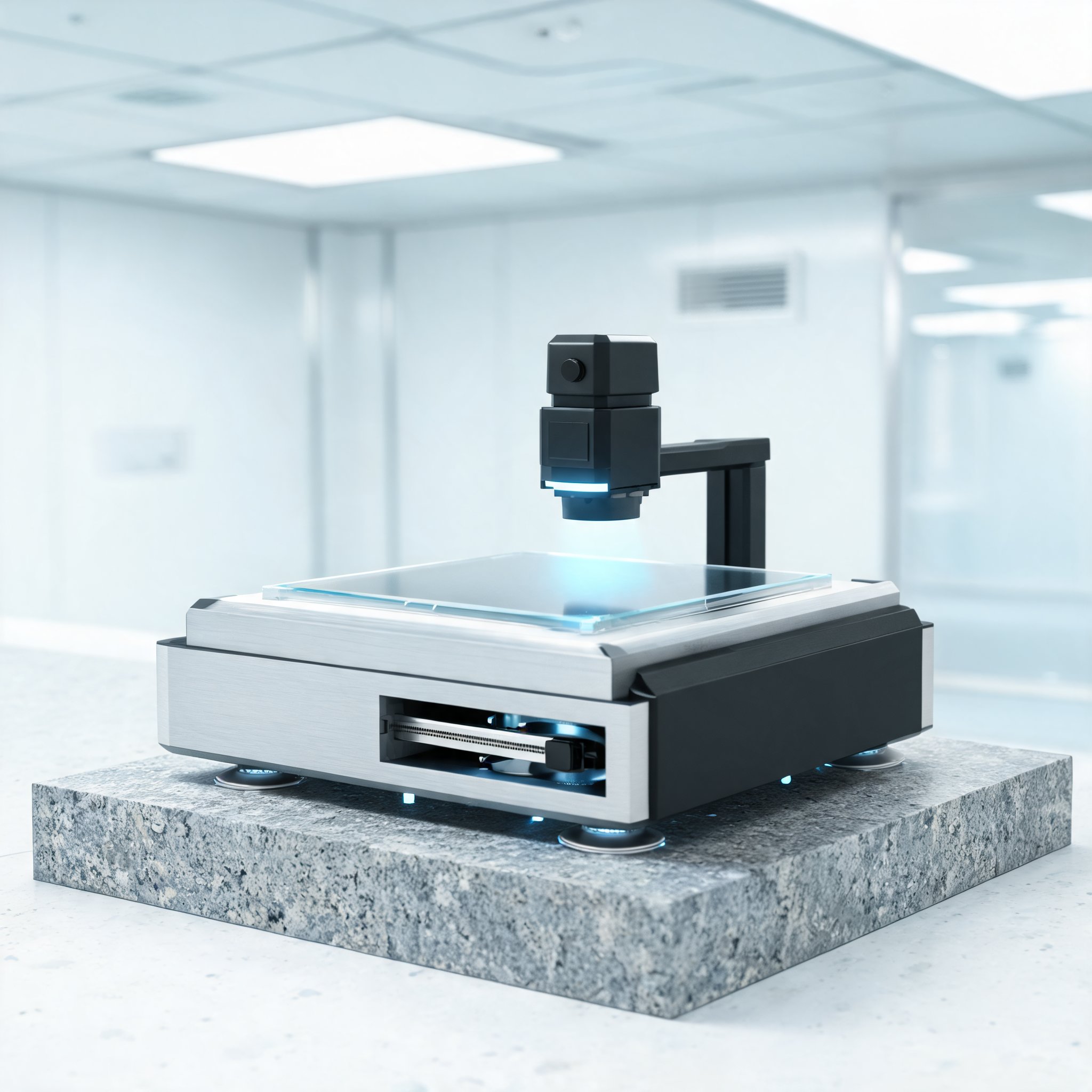
ETEL, part of HEIDENHAIN and a supplier of high-performance motion control components and complete motion platforms, has introduced the METIS HP, a full air-bearing planar platform for demanding step-and-scan semiconductor applications. The company said the platform is intended for direct laser writing and high-resolution optical inspection systems, where fast, stable scanning and precise trajectory control are required.
At the core of the METIS HP is a multi-degree-of-freedom HEIDENHAIN encoder. ETEL said the encoder helps maintain accuracy without thermal drift and supports projected tool-point measurement. The company's controllers can emulate a transistor-transistor logic position signal for use as a trigger event, an approach ETEL presents as an alternative to a classical interferometer used as an advanced trigger generator. Because the design does not require a mirror on the carriage, ETEL cites the absence of air lensing effects and air perturbation, along with lower cost.
ETEL lists ±150 nm accuracy over the full XY stroke after mapping, ±150 nm dynamic straightness at speeds up to 1 m/s, and dynamic capability reaching accelerations up to 20 m/s². According to the company, these characteristics reduce turnaround time and can increase machine throughput in step-and-scan applications. The company links the specifications to scanning processes that require speed stability and straightness at high velocity.
For high-end inspection in advanced packaging, rapid and precise focal-distance adjustment is important. The METIS HP includes a high-bandwidth four-degree-of-freedom module for fine control of the Z, tip, tilt and theta axes, which ETEL describes as suited to these inspection tasks. The platform supports panel sizes up to 600 mm × 600 mm, a format the company associates with next-generation maskless lithography on large-area substrates.
The METIS HP is an addition to ETEL's motion platform portfolio for semiconductor manufacturing and inspection equipment. Its stated design priorities combine speed, stability and dynamic straightness with measurement at the projected tool point. The encoder architecture is central to that combination: ETEL says it enables position information for triggering without the optical arrangement required by an interferometer-based approach.
Stéphane Pellegrini, product manager at ETEL, said the platform builds on the company's long-standing expertise in high-precision platforms and provides the trajectory quality required for advanced optical processes. He said its speed stability and dynamic straightness support consistent performance at high scanning velocities, while support for 600 mm × 600 mm panels addresses the growing need for next-generation maskless lithography with large-area substrates.