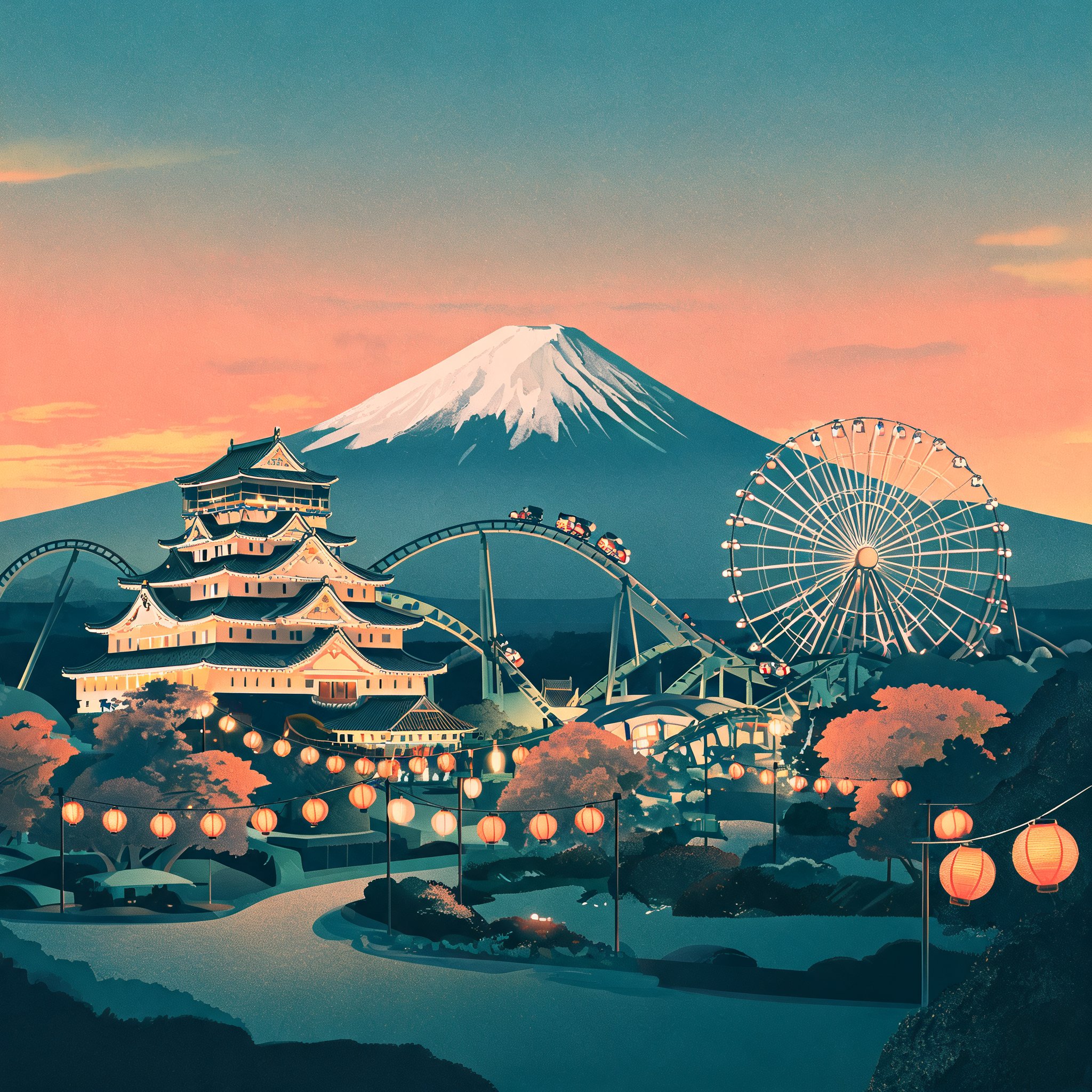
Japan’s theme park sector combines globally recognized resorts with regional attractions built around films, games, toys and characters. After a record 42.7 million international visitors in 2025, parks remain a major draw. A roundup of 18 parks highlights record-breaking coasters, immersive lands and recent or planned expansions.
Major destination parks
- Universal Studios Japan (Osaka, opened 2001) has Harry Potter, Jurassic Park and Minions areas. It opened the first Super Nintendo World in 2021 and the first Donkey Kong Country area in 2024, and announced plans to invest up to 300 billion yen in a 2026 expansion.
- Tokyo Disneyland opened in 1983 as Disney’s first park outside the US. Its 2026 Tomorrowland transformation, valued at 100 billion yen ($630 million), includes Space Mountain Earthrise and Sugar Rush: Sweet Rescue, with a new Space Mountain planned for 2027.
- Tokyo DisneySea opened in 2001 across 49 hectares. Its $2.2 billion Fantasy Springs expansion, opened in 2024, features worlds inspired by Frozen, Tangled and Peter Pan.
- Ghibli Park in Aichi brings Studio Ghibli films to life across five areas, including a Howl’s Moving Castle recreation and Catbus vehicles. In 2026, it announced a new Nausicaä-inspired indoor area.
Character and regional parks
- Sanrio Puroland in Tokyo opened in 1990 with Hello Kitty, My Melody and Cinnamoroll attractions, including a 2024 Cinnamoroll experience by Alterface.
- Fuji-Q Highland (1968) near Mount Fuji is known for coasters Fujiyama, Eejanaika and Takabisha, plus anime collaborations.
- Nagashima Spa Land (1966) near Nagoya has 13 coasters, the most in Japan, including Steel Dragon 2000.
- Huis Ten Bosch (1992) in Nagasaki recreates a Dutch town across 152 hectares, Japan’s largest theme park by area. It opened a premium flying theatre in 2025 and Miffy Wonder Square in 2025.
- Legoland Japan opened in Nagoya in 2017, with Miniland Japan built from more than 10 million Lego bricks.
- PokéPark Kanto opened in February 2026 at Yomiuriland, with more than 600 Pokémon across two zones and attractions Pika Pika Paradise and Vee Vee Voyage.
- Yomiuriland in Tokyo has more than 40 rides, including Bandit at up to 110 km/h, and attracted about 2.4 million visitors in 2024.
- Moominvalley Park opened in 2019 in Saitama as the first Moomin park outside Finland.
- Edo Wonderland Nikko Edomura recreates an Edo-period town across 49.5 hectares, with costumes, ninja performances and film sets.
- Asakusa Hanayashiki, established in 1853, is considered Japan’s oldest amusement park and has a roller coaster dating to 1953.
- Sylvanian Park in Ibaraki is a Sylvanian Families-themed attraction.
- Greenland in Kumamoto has around 80 attractions, a 105-metre Ferris wheel and coasters including NIO and Milky Way.
- Sanrio Harmonyland in Oita opened Nakayoku Lab in 2026, featuring an AR sky experience with Sanrio characters.
- Hirakata Park, Osaka’s oldest park (1910), has 45 attractions, including the 696-metre Elf coaster and the 1.3-kilometre Red Falcon.
The list reflects how Japan’s parks use large-scale investment, character tie-ins and cultural themes to draw visitors.