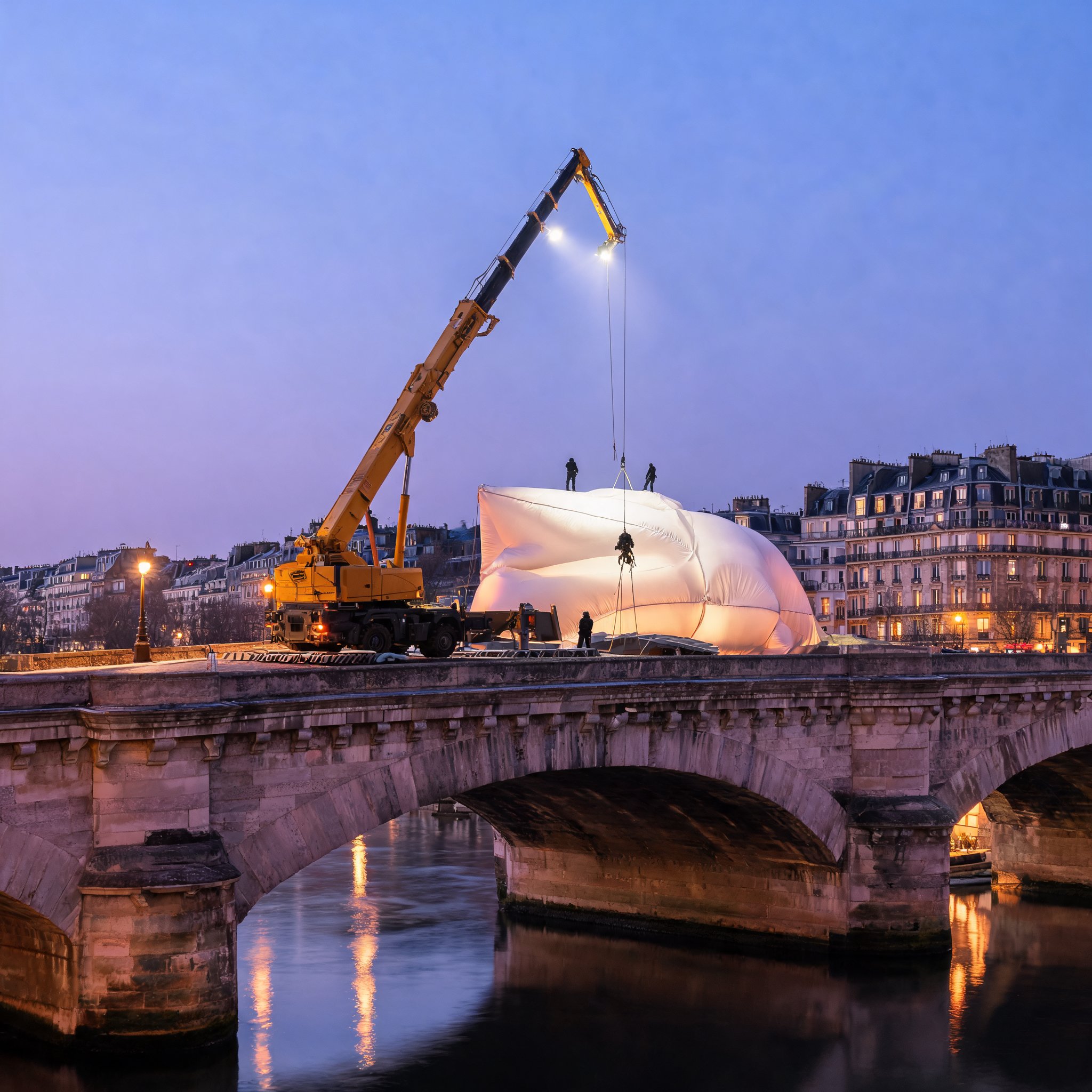
A Liebherr MK 88-4.1 mobile construction crane from the Ponticelli group has repaired a historic Paris bridge and reinstalled a damaged section of a temporary artwork. The work took place on the Pont-Neuf, where the crane restored part of La Caverne du Pont-Neuf, an installation by French artist JR. The crane's compact design, rapid deployment and reach allowed it to complete the task in the confined conditions of central Paris.
Storm damage and a confined site
The artwork was created as a tribute to the wrapping of the Pont-Neuf by Christo and Jeanne-Claude, first installed in 1985. The inflatable structure is approximately 120 metres long. In early June, violent gusts of wind and hail damaged parts of its outer shell. Within a few hours, French lifting and industrial services company Ponticelli had developed a lifting solution. Louis-Arthur de Quatrebarbes, head of the handling and lifting agency at Ponticelli, said the team was on site shortly after the damage occurred to work out the best technical solution with the client. Besides repairing the tarpaulin, the company had to carry out a safe lift in almost constant wind and under considerable time pressure.
A smaller crane for a tight historic setting
The Pont-Neuf is the oldest bridge in Paris, with limited space for work and a large number of daily visitors. Load-distribution plates were used to reduce ground pressure, while safety and traffic management measures supported the operation. The team had originally planned to use a larger Liebherr mobile crane, but the tight conditions led it to bring in the MK 88-4.1 instead. Its 45-metre trolley jib could reach all damaged areas of the structure, and its four-axle design made it easy to relocate from one side of the bridge to the other, where there was also storm damage. A short set-up time and a compact outrigger system further facilitated the work.
Night lifts in a wind corridor
The crane cab could move at working height, giving the operator a clear view of the approximately 18-metre-high structure and the rope access technicians. Boom-mounted spotlights lit the work area during night-time operations. The repair work was carried out over four night shifts. Damaged fabric sections weighing between 200 and 400 kilograms were lifted and reattached in collaboration with rope access technicians. Because the site is located in a wind corridor along the River Seine, weather conditions were monitored continuously, and communication between the crane operator and the rope access technicians took place via radio.
Preparations and positioning
Before work began, the team performed site inspections, load calculations and collision analyses of the surrounding buildings. A 360-degree test then confirmed the planned crane positioning. According to Ponticelli, the project was far more than a conventional lifting operation. De Quatrebarbes said the company was proud to have been part of the work of art, citing JR's view that the installation of the artwork is part of the artwork, and adding that the crane was part of it too. He described the MK crane's visually striking deployment as a magical moment.
Demonstrating inner-city capability
With its deployment on the Pont-Neuf, the Liebherr MK 88-4.1 demonstrated its strengths in demanding inner-city projects. Where heritage conservation, confined spaces and a high level of precision come together, the mobile construction crane offers a combination of reach, compactness and flexibility, according to the company. The project illustrates how a smaller, highly mobile crane can support sensitive repair work on a landmark site when access, ground pressure and public safety are tightly constrained.