A study published Oct. 13 in Optics Express reports that a custom-mixed LED spectrum rated at just 80 CRI helped people in their 70s and 80s sort colors more accurately than a daylight reference rated at 97 CRI. The result challenges the assumption that higher color-rendering scores always serve older viewers better.
The research from Fudan University in Shanghai, with two Opple Lighting employees among its eight authors, begins with a physiological problem. As the eye's lens yellows with age, it filters short-wavelength light. Ra and TM-30, the color metrics specifiers commonly use, are calculated with a fixed standard observer that does not account for lens aging, even though the CIE's 2006 physiological model includes an age parameter.
Two metrics, two optimized spectra
The team modeled color response in aging eyes and created two metrics. One estimates how much lost color discrimination a spectrum recovers for an older viewer; the other measures color fidelity against a 32-year-old's perception. It screened 11,541 candidate spectra from a 16-channel LED luminaire, all at 5000 K and Ra of at least 80.
Two candidates were tested against a simulated D50 daylight reference rated at Ra 97. P1 prioritized discrimination at Ra 80. P2 balanced discrimination and fidelity at Ra 90. When the authors re-ranked every candidate using the conventional standard observer, P1 lost its top position—showing that the spectrum favored by a spec sheet and the one favored by an aging eye can differ.
Small trial, measurable shifts
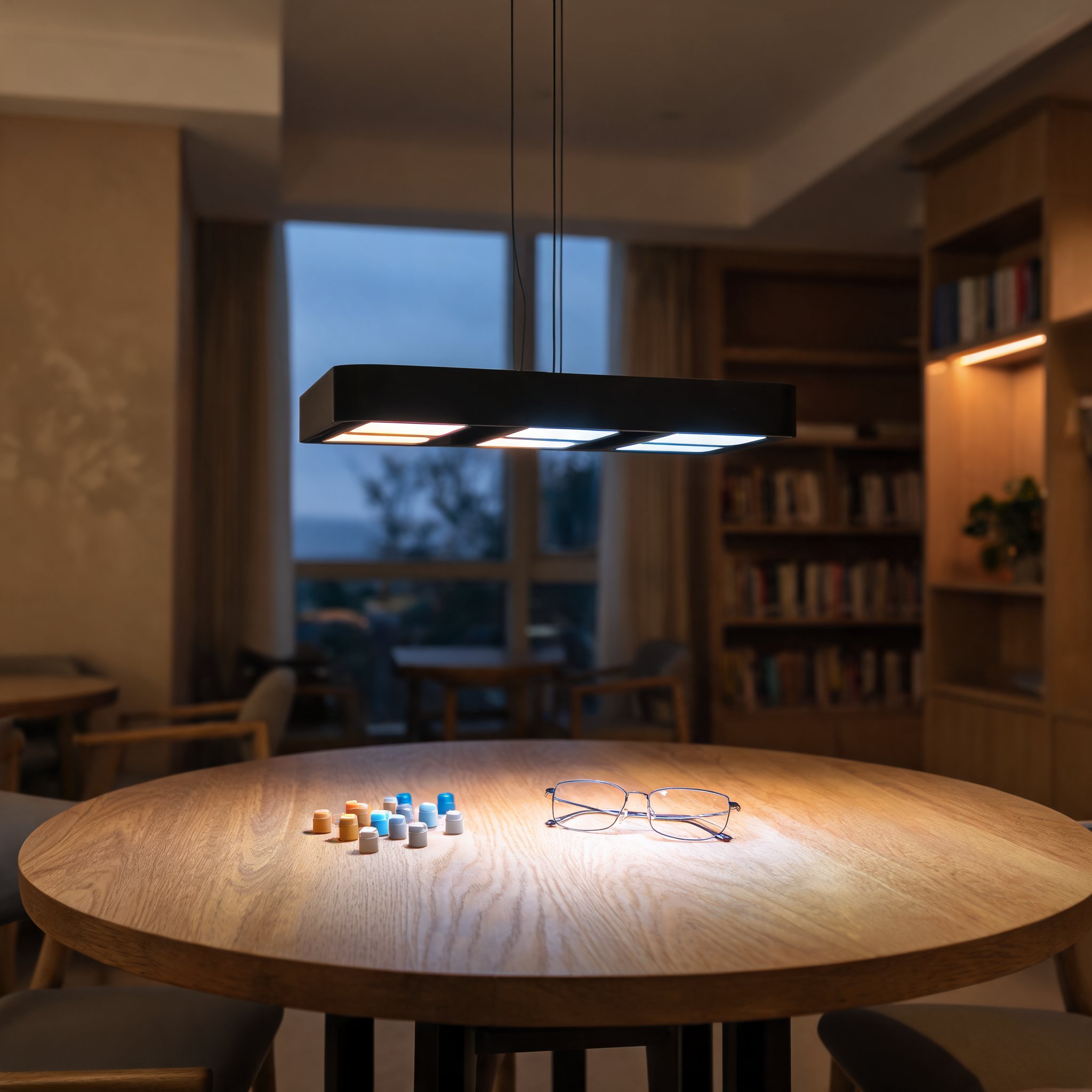
Participants aged 70 and older, with a mean age of 81.7, sorted colored caps from the Farnsworth-Munsell 100 Hue test in a viewing booth at 300 lux. Mean error scores fell from 79.2 under the reference to 62.4 under P1 and 65.0 under P2. Both reductions were statistically significant. Color discrimination improved for 26 of 34 participants (76.5%) under P1 and 22 of 34 (64.7%) under P2. The difference between the two optimized spectra was not statistically significant.
Asked whether fruits and vegetables looked natural, 28 participants said yes under P1, compared with 26 under both the reference and P2. The two-person difference is weak evidence, but it suggests that P1's lower Ra did not cost it in perceived naturalness.
Limits and product questions
The authors identify several constraints. The sample was small. People with advanced cataracts, glaucoma, or macular degeneration were excluded, removing many residents that memory-care designers light for. Chromaticity between reference and test lights was not perfectly matched, and the naturalness question was a simple yes or no. The authors also warn against reading 300 lux as a recommendation.
Opple financially supported the study, according to the paper's disclosures. The paper names no product, but a news release distributed through Optica, the journal's publisher, says Opple is working to translate the findings into lighting products. That makes the work early product development as much as academic research. The underlying data is available only on request, so independent replication matters.
The method requires at least four independently controlled LED channels. In the publication's market assessment, multichannel color-mixing fixtures rarely appear in care-facility bids, and most products sold as tunable in healthcare and senior living adjust color temperature across two channels, a configuration that would not reproduce these spectra. That product-availability gap is the publication's reading, not a claim in the paper.
For lighting professionals in senior living and healthcare, the study raises a practical question. Current color metrics make no allowance for aging eyes, while a growing share of building occupants are well past middle age. If a tuned spectrum can help residents read a medication label or judge whether food has spoiled, the next debate is how quickly such evidence reaches specifications and product lines—and whose products get there first.