Most discussions of horticulture's labor shortage begin with job postings, succession plans and the search for experienced growers. Jeff Neese, a Biological Solutions Advisor for BioWorks who covers greenhouse and nursery growers in the Great Lakes region, argues in a first-person essay that the search starts too late — in high school, or rather in the absence of horticulture there.
Neese traces his own entry into the trade to a vocational horticulture program at Warren Central High School in Indianapolis. He recalls walking into the school greenhouse during an Indiana winter: cold and gray outside, warm and green inside. At the time, he writes, he did not recognize that the doorway would determine the direction of his working life.
Expectations beyond worksheets
Two teachers shaped that experience. Phil Pitts brought experience as a grower and landscape designer and set demanding expectations for what students should know; Pam Greene taught floriculture, the segment of the industry that became central to Neese's later work. Together, Neese writes, they offered something he fears few students now receive — a chance to try horticulture before being asked to choose a career.
The coursework was not about memorizing plant names or raising a few plants for a spring fundraiser. Students were expected to understand plants and to grow them competently. Pitts, in Neese's account, made clear that production does not follow a school calendar: plants need water at weekends, insects and diseases do not wait for Monday, and crops respond to light, temperature, water and nutrition whether or not class is in session.
The assumption that college comes first
After graduation, Neese skipped college and went directly into horticulture. He is careful to say this is not an argument against university education, noting that the industry needs plant scientists, breeders, researchers and growers trained at that level. His point is narrower: college should not be the setting in which a young person first encounters horticulture, and a four-year degree should not be treated as the only credible entry route. More than four decades later, he is still working in the trade.
That matters to workforce development, he argues, because the industry's habitual conversation — difficulty finding growers with practical production experience, succession planning, recruiting graduates, developing assistant growers — presumes a pool of candidates that someone has already introduced to the field. A 15- or 16-year-old is unlikely to decide unprompted that greenhouse production sounds like a compelling career. Someone has to show them.
A greenhouse is a working laboratory, not a building
Neese is explicit that placing a greenhouse behind a school solves nothing by itself. Operating one demands knowledge, commitment and time. Agriculture teachers often cover broad subject areas, and he considers it unrealistic to expect each of them to double as an accomplished grower, crop scheduler, irrigation specialist, diagnostician, integrated pest management practitioner and environmental-control expert — or to acquire those skills alone.
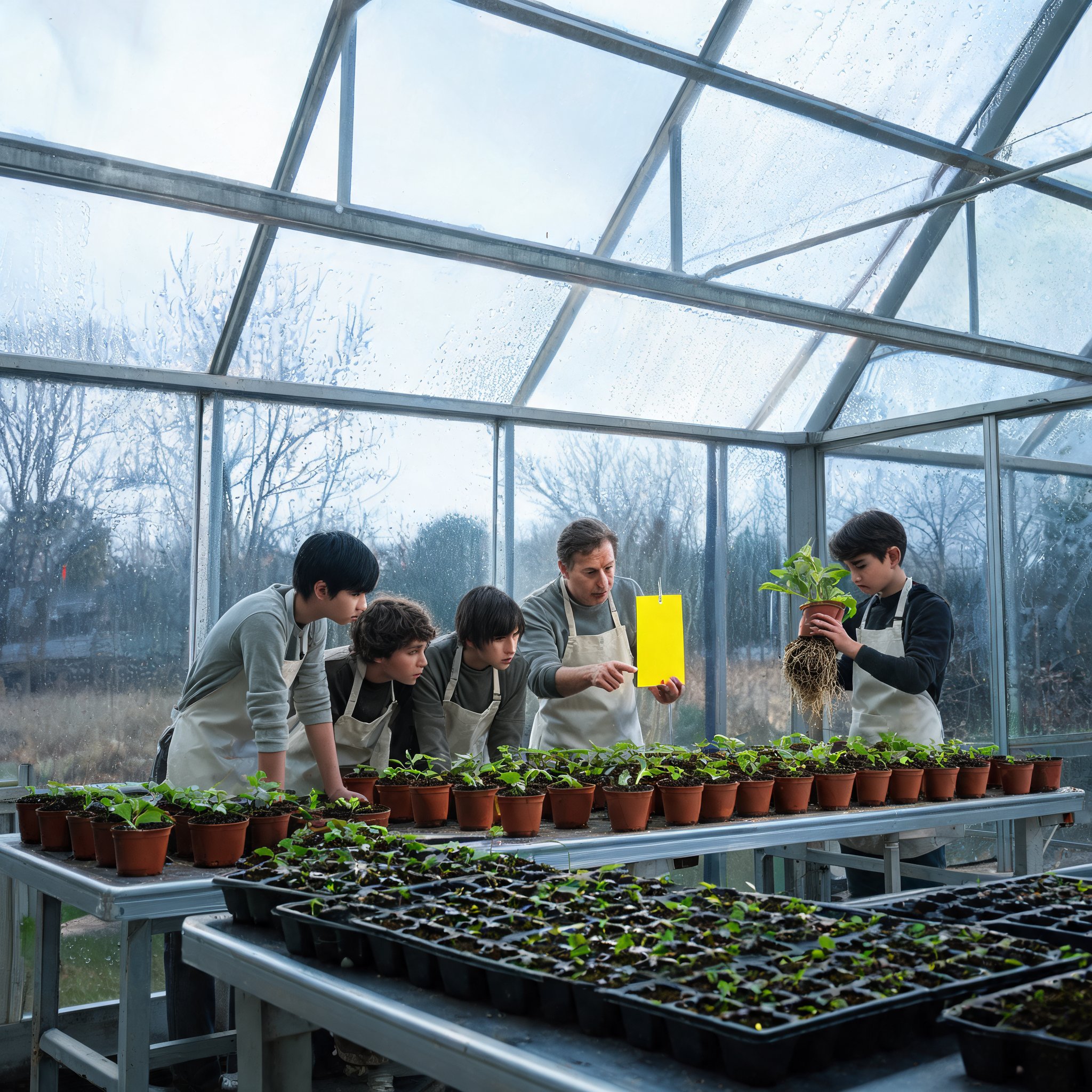
His proposal is that commercial operations effectively adopt their local school greenhouses. The aim would not be to seize the facility or dictate curriculum, but to serve as a technical resource: helping build a workable crop plan, setting realistic targets for irrigation, fertility, pH, EC, temperature and crop timing, and walking the greenhouse with students to teach scouting rather than simply naming a plant's problem. That includes showing how sticky cards are used, how roots are inspected and how nutritional disorders are diagnosed — and, above all, how growers reason through a problem and decide what to do. It also means helping teachers get more from equipment already on site, and giving them a knowledgeable person to call when something goes wrong.
The industry, he notes, holds a large body of practical growing knowledge that mostly stays inside commercial greenhouse walls. If workforce development is a genuine priority, some of it needs to reach classrooms. The goal is not for every instructor to already match Pitts or Greene, but for teachers to be surrounded by enough expertise and support that students can experience horticulture meaningfully.
What a summer internship does and does not show
Neese treats summer internships as valuable but insufficient on their own. For most high-school students, summer is the only extended period available for full-time work, and it can present a narrow slice of greenhouse production. Much of spring's variety may already be past; the weather is hot and humid; and as inexperienced seasonal employees, students can end up assigned whatever task no one else wants that day — sticking poinsettia cuttings, spacing crops, moving plants or cleaning houses.
None of that work is beneath anyone, he writes, and every grower should understand the physical labor of producing a crop. But if it is all a teenager sees, the industry should not be surprised when greenhouse horticulture fails to look like an appealing career. The student has experienced greenhouse labor, not greenhouse management.
Understanding production, in his view, requires exposure to how it changes across the year: fall crops and shortening days, winter's low light and humidity problems, spring propagation and the controlled intensity of peak season, summer heat, irrigation demand and preparation for the next cycle. Each stage brings different crops, different problems and different decisions. An eight-week internship, he writes, supplies one snapshot; learning horticulture requires the whole film.
Making the classroom and the commercial range extensions of each other
The remedy Neese proposes is tighter alignment. If a participating grower knows what students are studying, the summer job becomes the next chapter of their education rather than an unrelated paycheck. Students who have learned about pH and EC in class could see how a commercial operation monitors them; students studying scouting and IPM could join the person responsible for those programs on a crop walk; students who have covered irrigation and fertility could be shown injectors, water systems and the fertilizer program.
Even repetitive tasks gain meaning when the reasoning is explained. Rather than only teaching a student to stick a cutting, a grower can explain where that cutting fits in the production schedule, what happens during rooting, when the crop will be transplanted, what to watch for in the interim and why the finished-crop date matters. The physical work remains; it becomes a lesson.
Extended across the school year, the same partnership could involve growers visiting classrooms, assisting with crop planning, helping students troubleshoot their own greenhouse and inviting classes into commercial operations at different points in the cycle. By the time those students arrive for summer work, they would no longer be purely inexperienced seasonal labor.
Neese also frames the relationship as a recruiting channel. A student might first encounter a company as a sophomore taking horticulture classes, visit the greenhouse or work alongside a grower as a junior, and continue developing skills in the school greenhouse as a senior while maintaining contact with the operation. At graduation, that young person should not have to wonder whether horticulture offers a real career; the path should already be visible.
Treating an 18-year-old as a beginning horticulturist
For students who go on to college, Neese says the industry should encourage it. But for those who cannot attend, do not wish to, or — like him — simply want to start, there should be another respected route. An 18-year-old with several years of vocational horticulture, meaningful commercial exposure and mentorship from experienced growers should not be classified as unskilled labor. In his framing, that is a young horticulturist at the start of a career, and should be given responsibility, continued instruction and a clear view of where the work can lead.
He is equally clear about limits: schools cannot solve the industry's workforce problems alone, and commercial growers cannot sustain vocational education by themselves. The opportunity sits between the two. Growers can keep attending career fairs and wondering why applicants lack practical experience, or they can get involved earlier — locating the local agricultural education or horticulture program, meeting the teacher, walking the school greenhouse and asking what is needed, offering knowledge rather than only surplus equipment and leftover plants.
His practical suggestions include inviting students into a commercial range in February as well as June, letting them scout, test EC, examine roots and see both strong and troubled crops — and letting them make mistakes, ask questions and understand the decisions behind a quality crop. The closing argument is a challenge to growers: when students arrive for summer work, give them a reason to want that job someday rather than only the task nobody else wanted.
Somewhere, Neese writes, another teenager is walking into a greenhouse for the first time. The future of horticulture may already be sitting in a high-school classroom.